Some mornings you want an earring you forget you're wearing. Other mornings you want the pair that turns a plain white shirt into something deliberate. That is more or less the choice between studs and hoops, and it is worth making on purpose rather than grabbing whatever was left on the bedside table.
Both styles are endlessly useful, but they do different work. A stud adds a point of light close to the lobe; a hoop draws a line around your jaw and moves when you do. Which one suits you depends on your face, your hair, how long you plan to keep them in, and where you're going.
Face shape: where each style lands
Think of studs as punctuation and hoops as a shape. A stud stops the eye at the lobe. A hoop carries the eye outward and downward, which is why it can soften a strong jaw or add width to a narrow face — and why it can overwhelm delicate features if it is too large.
A few tendencies worth knowing:
- Round face: oval or elongated hoops add length and stop the face reading as one circle. Tiny round studs and small round hoops echo the roundness rather than balancing it.
- Angular jaw or square face: curves do the softening. A medium round hoop worn close to the head is often the easiest win.
- Oval face: almost everything works. This is the face shape that can carry a 60mm hoop as easily as a 4mm stud.
- Heart-shaped face or narrow chin: wider hoops and cluster studs add a little weight at the lobe, balancing a broader forehead.
- Long face: wide hoops and clusters add width; very long drops stretch the face further.
Treat these as tendencies, not rules. Where your ears sit on your head, how large your lobes are and how much hair frames your face matter more than any label. A quick test: take a photo straight-on in daylight, then hold a coin or a paper circle roughly the size of the hoop against your ear. If your face looks balanced rather than pulled in one direction, the size is right.
Hair length changes everything
Hair decides whether an earring is seen far more than the earring does.
Short crops and pixies. The ear is on show, so earrings carry the whole look. Medium hoops of roughly 25–35mm have presence without tipping into costume. Large hoops work here too, but keep the metal fine so they read as line rather than mass.
Bobs. A chin-length bob frames the ear and swallows small studs entirely. A 15–25mm huggie, or two or three small studs stacked up the lobe, will actually be visible.
Long hair worn down. Studs disappear. If you rarely tie your hair back, move them up the lobe or go slightly larger — a 6mm stone or a small cluster rather than a 3mm dot. Hoops of 30mm and above catch light between strands and read from across a room.
Curls and volume. Dense hair eats detail. Smooth, simple shapes hold their own better than anything intricate.
Hair up is its own switch. The studs that vanish when your hair is loose suddenly look like the point of the outfit, and a large hoop that felt like too much at breakfast looks exactly right at eight in the evening.
Comfort, weight and everyday wear
Comfort comes down to diameter, gauge and closure. A wide, paper-thin hoop in a light metal can be easier to wear all day than a small, solid one. A thick gauge through a small hole is the usual culprit behind that dull ache by mid-afternoon.
If you sleep in your earrings — plenty of people do — huggies and sleepers with a click or hinge closure are the practical choice. A butterfly-backed stud presses into the side of your neck when you lie down; a hoop rotates and mostly gets out of the way.
If you wear headphones, scarves or lanyards all day, studs snag less. Long hoops catch on collars, cables and knitwear, particularly when you pull a jumper over your head.
If your ears are sensitive, the metal matters. Nickel is a common irritant, so look for titanium, niobium or high-carat gold, and think twice about plated or unmarked metals for anything worn daily. If a piercing becomes red, hot or weeping, take the earring out, keep the area clean and speak to a pharmacist, doctor or professional piercer rather than pushing through it.
Wear new earrings for a short stretch first. Two hours at home tells you more about weight than ten minutes in front of a changing-room mirror.
Occasion: what reads right when
- Work and meetings: studs, pearls or slim huggies — nothing that clicks against a headset.
- Interviews and first days: small studs. You want to be remembered for what you said.
- Evening and dinners: this is where hoops earn their place. A polished 40mm hoop with your hair up does more than any necklace.
- Weddings and formal events: pearl or stone studs for classic, fine hoops for modern.
- Gym, swimming and sport: flat studs or small huggies. Take them out before swimming; chlorine is hard on platings and finishes.
- Travel: small studs. Nothing pressing into a plane pillow or catching on a seatbelt.
- Photographs: hoops read from a distance. Studs, unless they are a good size, tend to disappear.
Mixing hoops and studs
You do not have to pick a side. A stacked lobe is the easiest way to wear both: small studs in the first and second holes, a huggie in the third, or a huggie low and a larger hoop higher up if your anatomy allows. Keep one statement per ear so the arrangement looks considered rather than crowded.
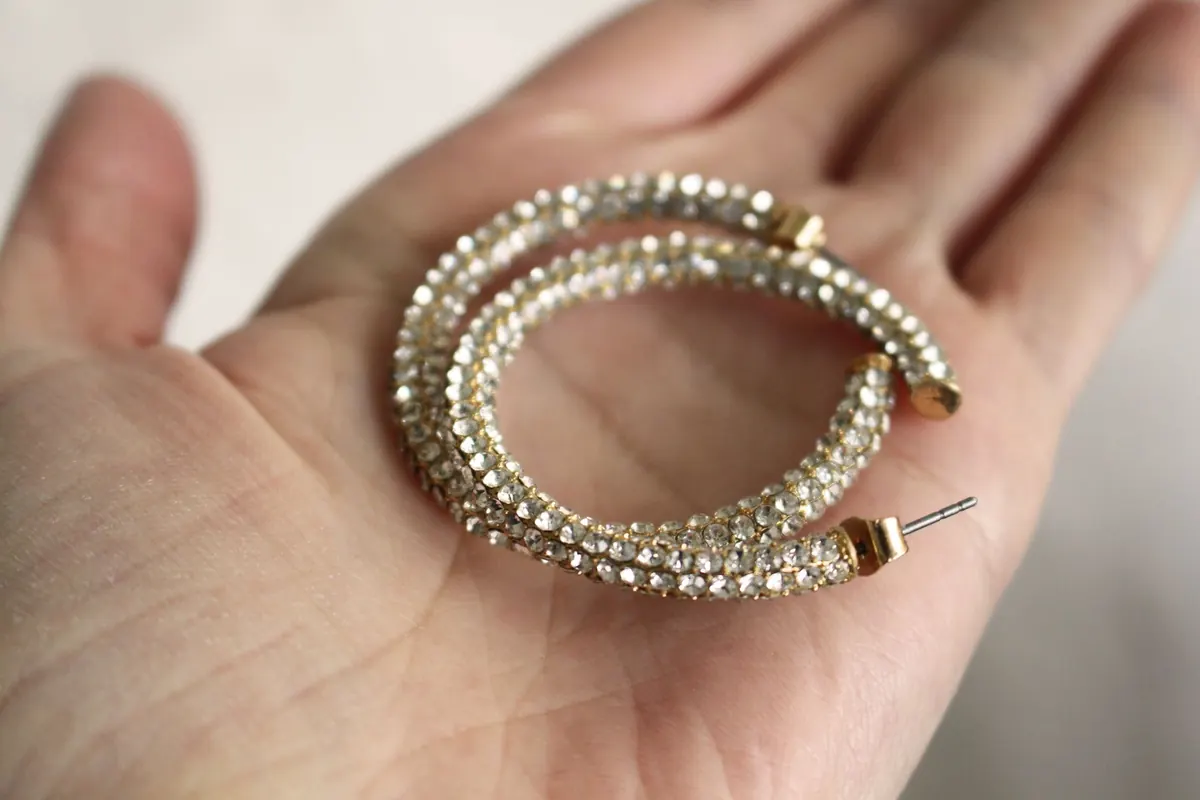
If you are building from scratch, five pairs cover almost everything: 6mm studs, pearl or stone studs, 20mm huggies, 40mm polished hoops, and one pair with texture or a bit of weight for evenings. Choose two metals you actually wear and stick to them, so the collection works together.
Trying them on: a practical check
Before you commit, stand in daylight with your hair as you normally wear it and put a hoop on one ear and a stud on the other. Turn your head side to side, then look down and up. Compare, then swap.
Leave the winner in for an hour around the house. Check that the hoop clears your jaw when you turn, that the closure holds when you tug it gently, and that you can put a jumper on without a fight. Confirm the gauge suits your piercing — if it feels tight going in, it is the wrong size. As a rule, remove plated earrings before showering or swimming, wipe them after wear, and store pairs separately to avoid scratches. If any piercing is new or healing, let a professional piercer guide your choice of metal and weight before you swap anything in.
Photo: Yulia Shapereva s / Pexels